Does the Fragmentation AI module have a feature that allows users to highlight the Xmax position or custom specific size is in the muckpile?
Yes, our fragmentation analysis module has this feature.
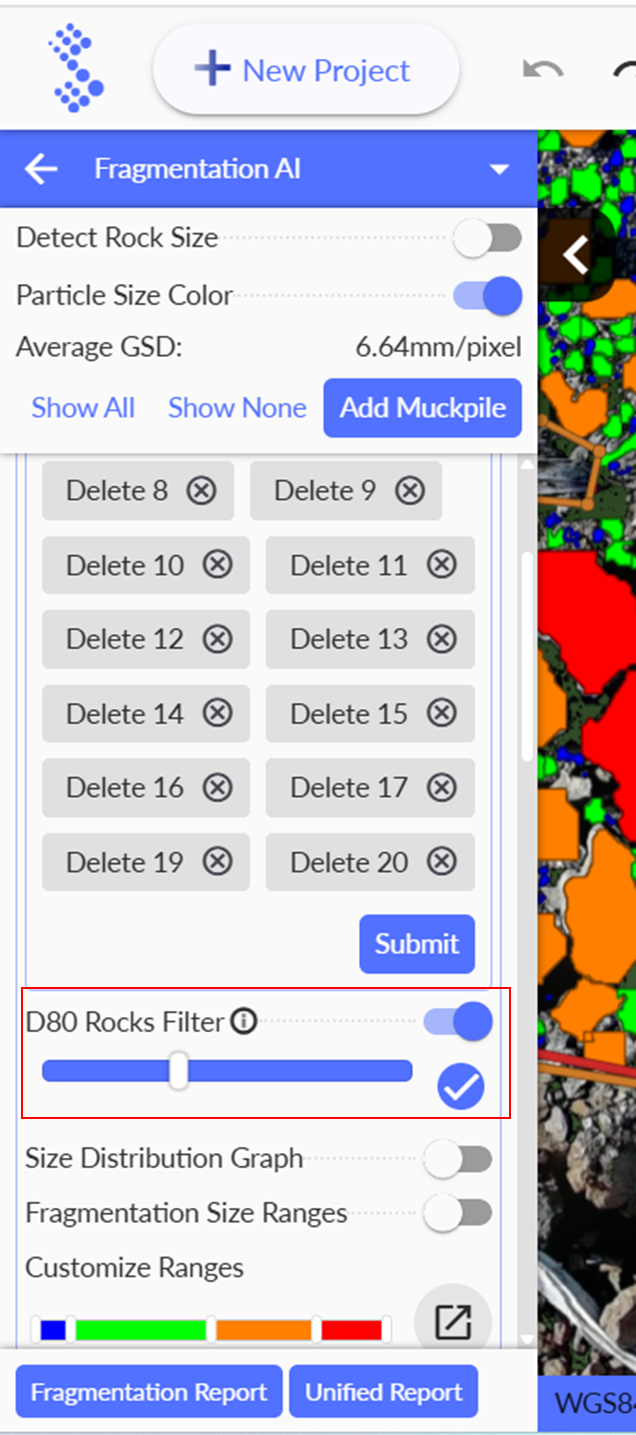
The D80 Rock Filter tool, which performs the function, is illustrated in the image below. First, toggle on the "D80 Rocks Filter", then adjust its size to match the size of the particle you wish to see in the picture.
This feature shows the larger particle size material, which can further be used to locate the size above the Xmax and eliminate it from the PSD graph.
Related Articles
Fragmentation AI: Customizing Particle Size Ranges and Editing Individual Rock Nodes
When using the fragmentation AI within Strayos, users have the option to manually adjust and categorize the rock sizing and muck pile boundaries as needed to ensure the accuracy of data being reported. To begin, select the post blast dataset you are ...
Measuring muckpile shape and cast with Muckpile AI
Introduction The Muckpile AI module allows you to view an automated report on muckpile movement and cast. The muckpile is automatically detected by AI and analysed in a series of cross sections. Capturing the data Fly a drone over the muckpile and ...
Fragmentation Analysis - User Guide
Overview Strayos uses deep learning algorithms to automatically detect rock boundaries and calculate fragmentation particle size distributions. Activating the analysis This analysis is triggered at the project upload stage by activating the ...
How the fragmentation AI works
Obtaining rock contours Pipeline 1) Pre-processing Input is an orthographic RGB image with resolution . Since the input orthographic image could cover an area and such image could have size , to avoid the Out-Of-Memory problems algorithm splits the ...
Fragmentation Prediction
Overview Strayos provides you the most accurate fragmentation predictions possible by automatically calibrating them using previous blasts. The prediction models continually learn and improve as you use the Fragmentation Prediction and Fragmentation ...